“Phase 2″ of COVID-19 Emergency Containment in Italy: DPCM 26 April 2020
#Italy
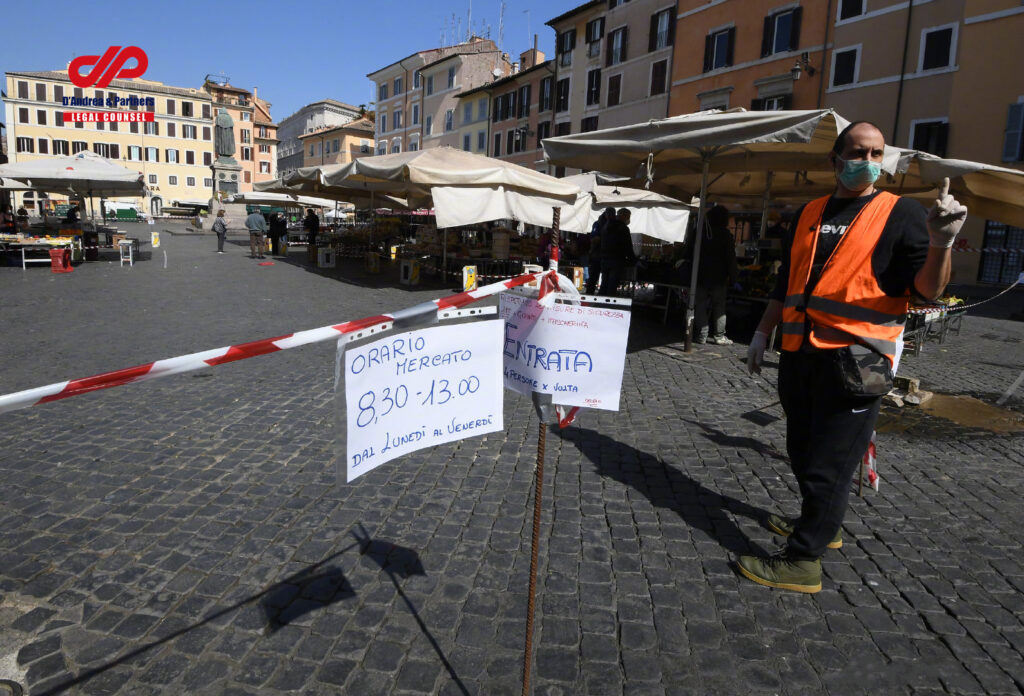
With the approval of the Decree of the President of the Council of Ministers dated 26th of April 2020 (hereinafter referred to as “DPCM 26/4”), Italy is preparing to enter the so-called “Phase Two” of the COVID-19 emergency containment measures.
The DPCM 26/4 replaces the previous Prime Ministerial Decree dated the 10th of April and will apply from the 4th of May until the 17th of May 2020, the date on which, on the basis of what has been reported by the Prime Minister Giuseppe Conte, the new measures will be revised in a less restrictive manner with the gradual and progressive reopening of retail businesses, restaurants, museums, exhibitions and libraries.
We shall report below the main provisions of the DPCM 26/4, particularly in relation to (1) restrictions on personal travel; (2) the performance of retail trade activities; (3) the performance of professional activities; (4) the performance of industrial and commercial production activities.
With regard to (1) the restrictions on personal movement, the new Decree clarifies the following (art. 1):
Movements within the same Region are permitted as long as they are motivated by (i) proven occupational needs, or (ii) situations of need or for (iii) health reasons. Movements to meet relatives are considered necessary as long as the ban on groups and social distancing of at least one meter is respected and respiratory protection is used.
Movements Between Regions are prohibited except for (i) work requirements, (ii) absolute urgency, (iii) health reasons.
In any case, people are allowed to return to their own domicile, household or residence. With regard to (2) the performance of retail business activities, Article 1 provides:
The suspension of all of the above activities, with the exception of groceries and basic necessary sales activities, which are analytically listed in Annex 1 of the Prime Ministerial Decree 26/4, as well as the personal services activities listed in Annex 2 (laundries, funeral services);
Newsstands, tobacconists, pharmacies and drugstores should remain open, as long as the social distancing of one meter is guaranteed;
Banking, financial and insurance services and the activities of the agricultural, zootechnical and agri-food processing sectors are guaranteed, in compliance with health and hygiene regulations.
With regard to (3) the performance of professional activities, Article 1 recommends:
The use of smart-working systems to the maximum possible extent, for those activities which may be carried out at home or remotely;
The encouragement of paid holidays and paid leave for employees and other collective bargaining tools;
The implementation of anti-infection safety protocols, with the adoption of individual protection instruments (e.g. masks) when it is not possible to respect social distancing of one meter;
The encouragement of sanitizing operations.
With regard to (4) the performance of industrial and commercial production activities, Article 2 provides:
The suspension of all the above activities, except those listed in Annex 3 of DPCM 16/4. In particular, manufacturing, construction, real estate intermediation, wholesale trade and accommodation activities may restart.
Companies that may resume their activities will have to comply with the provisions enclosed in the shared protocol for the regulation of measures to contrast and contain the spread of COVID-19 virus in the workplace signed on the 24th of April 2020 among the Government and social partners. By way of example, these prescriptions include the measurement of employees’ temperature at the entrance of the workplace, daily cleaning and sanitizing of the premises, the provision of hand sanitizers, the imposition of social distancing of at least one meter or, where this is not possible, the mandatory use of masks and other protective devices.
In the contemporary commercial landscape, intellectual property assumes an indispensable role for enterprises, irrespective of their sector or scale of operation. Indeed, intellectual property rights stand as a cornerstone in safeguarding a company’s competitiveness, prosperity, and enduring existence, exerting a substantial influence on its overall worth. These rights pertain to intangible assets, encompassing trademarks, patents,
Article 27 of the Italian Constitution enshrines the principle that criminal liability is personal. This principle is one of the pillars of the country’s legal system, providing that no one can be punished for an offence he or she did not commit personally, since criminal liability is closely linked to the individual action and will
In today’s globalized business landscape, companies come to manage labor disputes. The intricate interplay of local laws, cultural nuances, and procedural requirements significantly shapes the resolution process. This article embarks on a comparative journey through four distinct jurisdictions—China, India, Italy, and Vietnam—to illuminate the strategies and challenges involved in addressing labor disputes. Central to this
#China
#Italy
#India
#Vietnam
Manage Consent
To provide the best experiences, we use technologies like cookies to store and/or access device information. Consenting to these technologies will allow us to process data such as browsing behavior or unique IDs on this site. Not consenting or withdrawing consent, may adversely affect certain features and functions.
Functional
Always active
The technical storage or access is strictly necessary for the legitimate purpose of enabling the use of a specific service explicitly requested by the subscriber or user, or for the sole purpose of carrying out the transmission of a communication over an electronic communications network.
Preferences
The technical storage or access is necessary for the legitimate purpose of storing preferences that are not requested by the subscriber or user.
Statistics
The technical storage or access that is used exclusively for statistical purposes.The technical storage or access that is used exclusively for anonymous statistical purposes. Without a subpoena, voluntary compliance on the part of your Internet Service Provider, or additional records from a third party, information stored or retrieved for this purpose alone cannot usually be used to identify you.
Marketing
The technical storage or access is required to create user profiles to send advertising, or to track the user on a website or across several websites for similar marketing purposes.
To provide the best experiences, we use technologies like cookies to store and/or access device information. Consenting to these technologies will allow us to process data such as browsing behavior or unique IDs on this site. Not consenting or withdrawing consent, may adversely affect certain features and functions.
Functional
Always active
The technical storage or access is strictly necessary for the legitimate purpose of enabling the use of a specific service explicitly requested by the subscriber or user, or for the sole purpose of carrying out the transmission of a communication over an electronic communications network.
Preferences
The technical storage or access is necessary for the legitimate purpose of storing preferences that are not requested by the subscriber or user.
Statistics
The technical storage or access that is used exclusively for statistical purposes.The technical storage or access that is used exclusively for anonymous statistical purposes. Without a subpoena, voluntary compliance on the part of your Internet Service Provider, or additional records from a third party, information stored or retrieved for this purpose alone cannot usually be used to identify you.
Marketing
The technical storage or access is required to create user profiles to send advertising, or to track the user on a website or across several websites for similar marketing purposes.